Expiration Dates & You
Howdy Vados!
It’s Jonathan here with another signature DR:TX Rules Ramble, covering an important upcoming logistics note for our next game — The DR Live Scrap Expiration, aka The Great Scrap-ening, Great Break-ening, or various other names coined by players over the last year.
TL;DR: This may be a surprise for some, so let’s pull the band-aid off right away. In case you might have forgotten over the past year:
Unmarked Scrap cards expire on February 1st, 2026 — BEFORE our next game
Our photos for this post were taken from previous DR:TX events by our talented Photo Team, including Lily-Jay Jones, Miranda Farmer, Heather Halstead, Noah Goodman, and Max Pohlmeier.
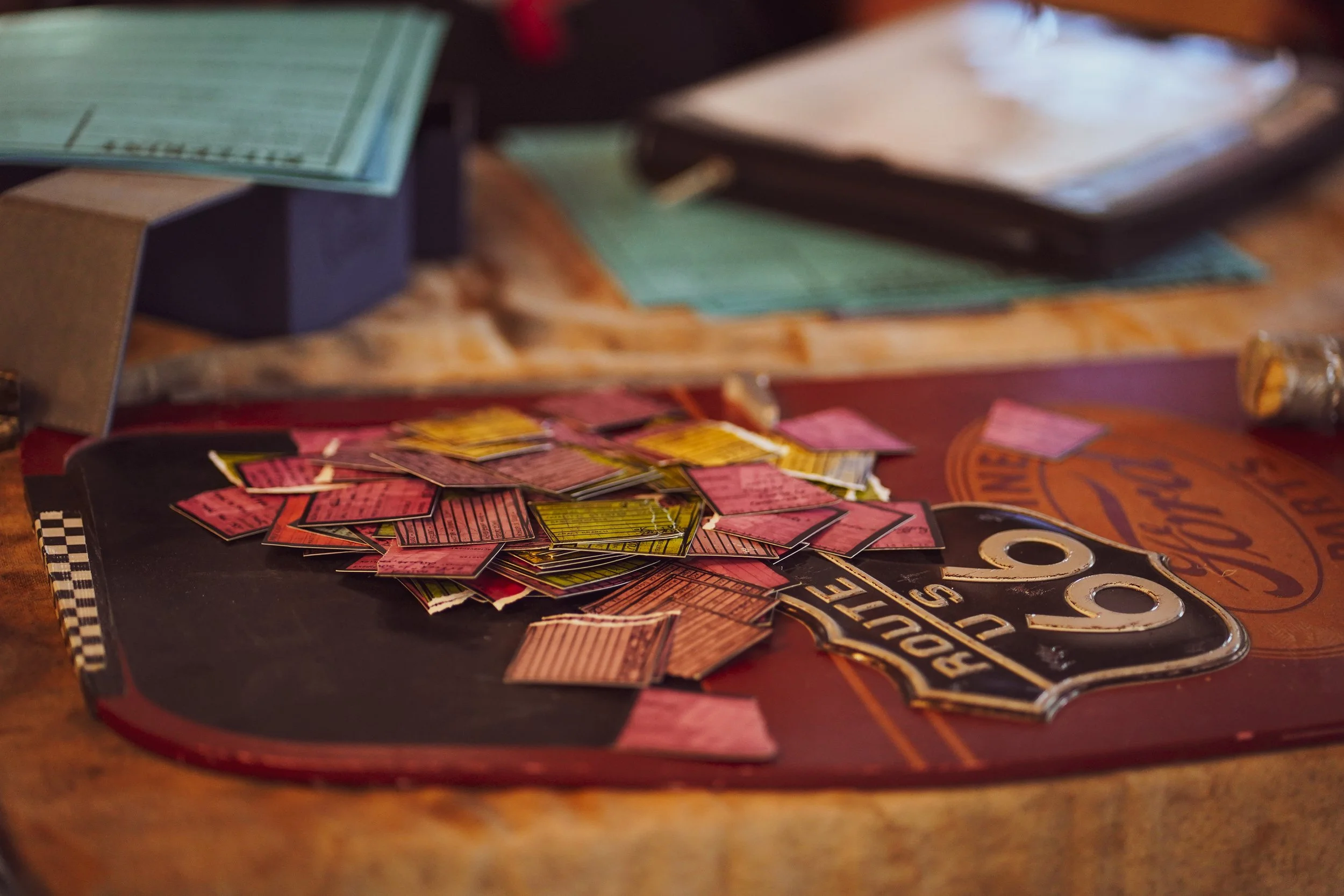
all Scrap now has an expiration date…
Let’s talk about this.
If you’ve been playing since before DR Live began last year, or perhaps just traded or bartered for existing scrap cards, you might find yourself with cards that have NO date. Under previous editions of Dystopia Rising, Scrap did not have usually have an expiration date. This scrap has been traded and passed around over the years, and most of the oldest cards have passed out of circulation. There’s at least four different variants of Scrap cards you might see out there, dating from the first days of DR over a decade ago.
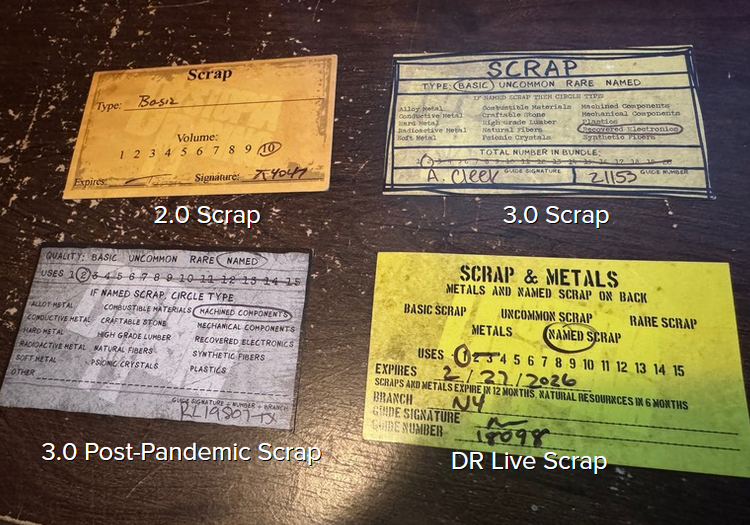
DR Live added expiration dates to Scrap and this was a pretty big change at the start of this new edition (Player’s Guide, p. 89). We did a lot of the item card transitions last year either at our National event or during the first few games of DR Live for crafted items, but the Network delayed the expiration of existing scrap items for a year after launch.
Back last year, the Network Support team published the mechanics for this changeover during our Q4 Network meeting. Here’s the specific section of the Item Transition from the Network Support team:
Any item without an expiration date (scrap, herb, produce, etc) will be given a 1 year expiration date. Any items not on new item card expire February 1st 2026. This does not apply to expired items.
This means that ALL Scrap cards without a date on them will be expired BEFORE our next event in February.
What does this mean for you?
These old expired cards will not be honored during our next event, and there are no existing mechanics that offer a use for these types of expired cards. In fact, there’s only one Blueprint that even uses expired items and it’s limited to Herb that has expired in the last few months. We can’t convert these expired cards for you, or create local mechanics to convert them. If you didn’t manage to convert these cards before now, these are ultimately just collector’s items or cards to be torn up and trashed.
If you didn’t find a use for these items over the last year, there’s very few options to convert a horde of cards before our next event. The timing of this change means that there are only two in-person events scheduled within the next month that fall before our event, in Washington and New York. That’s a bit far to travel to convert items, so let’s instead talk about the next steps for most of our folks.
It’s okay to have some feelings about this date finally arriving. Losing item cards in game is never easy, but there’s always a risk of in-game theft by other survivors and threats, and there’s even a few monsters that can suddenly destroy items. If you have any questions or concerns about this change, feel free to send us an email.
The Good News
Players that have been with us since earlier editions have had a pretty serious advantage over these last few months. Some players had literally thousands of scrap cards collected over the years, and this glut of resources was hard to compete with. It made finding items fairly easy in game, but it meant that there wasn’t a lot of need to create new items in game. Scrap was reliable, as it didn’t expire, so it just kept building up into massive hordes of item cards. With this new expiration date, everyone will be on a more level playing field, needing to forage and scavenge for these resources once more. This is going to mean some big changes for the in-game economy, and that is super exciting!
This change really allows us to dig into the stories of survival in a hostile wasteland. This struggle to find resources really taps into the challenges of dealing with your fellow survivors and trying to find resources in the wasteland. This will help provoke more conflict and interaction and gives some new focus for CVC and working with different NPC groups to establish trade. Where you spend your hard-earned scrap will be a more impactful choice when it isn’t coming from a horde of scrap that’s been there for years.
Lastly, items are not nearly as necessary in this new edition as in previous ones. Most of the power of a character in DR Live is really in their Impact Skills and Development Skills, not equipment. There’s just not as much need to have giant stores of scrap, as most weapons and armor only need five total scrap to create. This is considerably cheaper than in previous editions, so now it’s very possible to gather the materials you need for a new item in a single game. This also means that there will be many new opportunities for others to join in the economy game of DR, so it’s a brave new world.

How do I get Scrap in DR Live?
There are various types of Scrap in DR Live. You can find most of these rules in the Player’s Guide, but I’ve also written a few additional resources on our website. You can read more about most item cards in the Scrap & Herb Guide, and I’ve covered some longer thoughts in Turbo’s Guide to the Economy. You can also find information starting on page. 86 in the Guide’s Guide.
Scrap can be found in game, acquired via certain Skills, seeded via NPCs or in-game events, and can be traded, stolen, or used in game. Scrap item cards represent materials that are harvested, recovered, or scrounged. These materials are not considered to be “pure” states of the material but instead are ores, scraps, or refuse that has the resources inside them. Scrap item cards normally have a 12- month expiration date, but Natural Resources have a 6- month expiration date.
Scrap comes in a few varieties, from the generic types of Basic Scrap, Uncommon Scrap, and Rare Scrap, to the harder to acquire Named Scrap. Named Scrap comes in three categories, Metals, Natural Resources, and Trade Resources, each with five different types. All in all, there are 18 different types of scrap you can find in game, and these are used in various Artisan Blueprints.
Generic: Basic, Uncommon, Rare
Metals: Alloy Metal, Conductive Metal, Hard Metal, Radioactive Metal, and Soft Metal
Natural Resources: Craftable Stone, High Grade Lumber, Combustible Materials, Natural Fibers, and Psionic Crystals
Trade Resources: Machined Components, Mechanical Components, Recovered Electronics, Synthetic Fibers, and Plastics.
Outside of acquiring these items from other players, NPCs, or events in game, there are several reliable ways to generate these items in game. Let’s cover the most common methods to acquire Scrap cards:
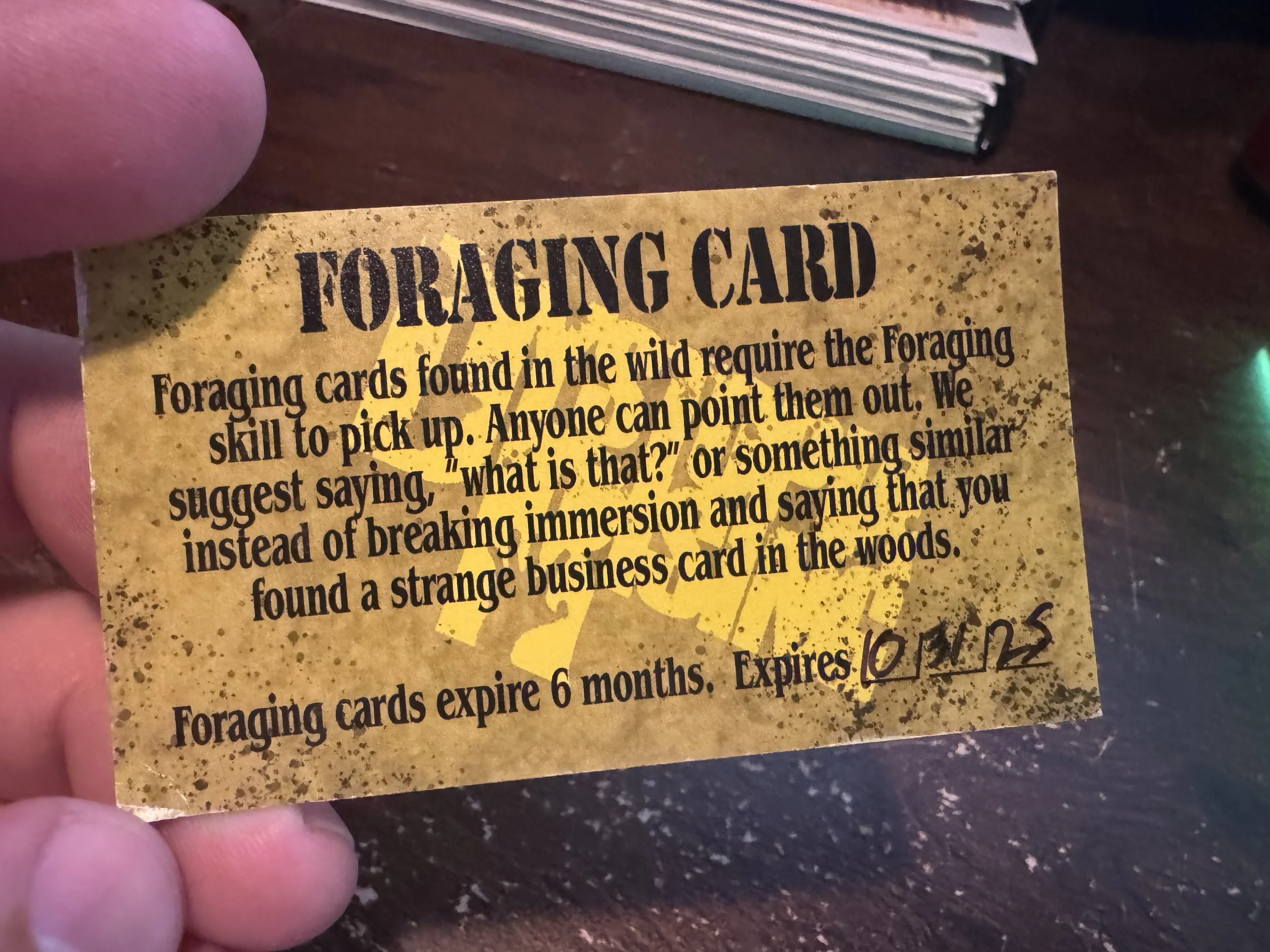
Foraging (Pg. 47, Player’s Guide)
During each DR:TX event, we seed a number of Foraging Cards across the campsite. We usually release between 1 to 2.5 cards per pre-registered player, so that means that somewhere between 80-120 cards are made available each game. You can find the complete rules for this distribution on page 94 of the Guide’s Guide.
We distribute these cards across each of our ST shifts over the weekend, so there’s generally new cards available every four hours or so, depending on the schedule of events. These cards will be hidden around the campsite, around trees and brush, behind rocks, or even included as part of a mod. If you pay attention, anyone can point out a card they find in game, and I’ve included a picture of a Foraging card here so you know what to look for.
Foraging cards can only be collected and turned in by a character with the Foraging development skill. These cards usually generate Basic, Uncommon, Rare, and Natural Resources. Natural Resources only have a 6-month expiration date, so they have a bit shorter shelf life than the other types of scrap, and the Foraging cards themselves expire after 6-months as well.
Basic Foraging can spend 1 Mind to produce the user’s choice of High Grade Lumber, Craftable Stone, or Basic Scrap. Higher levels of the skill can create Combustible Materials, Natural Fibers, and Psionic Crystals. This is one of the cheaper ways to acquire Basic Scrap in game.
The Dirt Engineer's Toolkit allows you to spend 5 mind to get an Uncommon or Rare Scrap instead from a Foraging card.
Tabernacle Trail Mix and the Outer Patrol Labor Contract can be used to generate additional items from a single Foraging card.
The Future Investments Contract can even generate Currency from Foraging cards.
With Proficient Foraging and 1 Resolve, or by using the Vaguely Trustworthy Map Set, you can force a Foraging card into existence. This is a great way to get these resources if you can’t manage to find a Foraging card in play.
There’s one other major use of Foraging, but that deserves it’s own section.
Salvaging (p. 41, Player’s Guide)
The other mostly “free” way of acquiring Scrap is through the Salvaging impact skill. This is a useful skill in combat, but it can only really be used on the dangerous Raider threats. This skill is a bit more reliant on Raiders actually being in play, or you being in the right place during a fight, so it can be a bit harder to rely on for gathering Scrap.
Here’s the mechanics, from page 41:
With this skill, users may role-play looting from a newly dead Target Raider to salvage a single Scrap. Raiders may have Basic Scrap (for low-level threats), Uncommon Scrap (for high-level threats), or Rare Scrap (for epic-level threats). This scrap is in addition to any loot that a Raider may have on them. Once a Raider has been salvaged, the player portraying the Raider should go out of character and report to their Guide for either their next respawn or to return to Ops. Each Raider can only be salvaged once.
No Scrap Card: If the player portraying the Raider does not have a Scrap card, ask them to report to their Guide out of character (OOC) so the Guide can provide the Scrap card after combat is complete. All Raiders are equipped with Scrap.
Salvaging usually creates Basic Scrap, Uncommon Scrap, Rare Scrap, and sometimes Named Metals. in practice, you’ll usually only get Basic and Uncommon, as Rare Scrap is only found on the higher Rank threats like Raider Champions. These are much more deadly threats, so they are far less likely to be included in the usual wandering threats we send out during game.
There’s a few ways to modify the use of this skill:
The Dross Harvesting Kit can generate an additional Scrap, but only when used on a Rank 2 or higher Raider.
The Green Light Cleaver is one of the few ways to use Salvaging on a non-Raider target, allowing you to gather Produce: Meat from a fallen Critter corpse. The Meatiest Meat Cleaver allows you get Produce: Meat from the usual Raider corpse.
The Scavenger Profession can use the Gimme Your Kicks impact skill to gain an additional Basic Scrap from a downed Raider. You can even used the Misused Dentistry Tools or the Lucky Poker Chip to gather higher tiers of scrap or even Currency.
Scrap Farming, aka the Helscape Mine
The most reliable method of acquiring Scrap is from the humble Helscape Mine. This Engineered Space allows any character with the Basic Foraging skill to reliably “farm” scrap, producing Basic, Uncommon, and Rare Scrap for mind points and time.
Here’s the mechanics of note:
A user may spend 10 Minutes of Active Roleplay interacting with the mine and spend Mind at 5/10/15 points to get Basic/Uncommon/Rare Scrap accordingly. They may instead spend 30 minutes doing extra NPC shift to get a Named Scrap of their choice.
This area is a bit expensive to craft, but it lasts for two years once constructed. Remember that an Engineered Space needs to have an approved area of props and decorations to be used in game, but this will be an important resource in the coming events. If you are willing to put in some NPC time, you can acquire ANY type of scrap in the game. This will be the usual way I expect to see Basic Scrap enter play going forward, as you are not reliant on finding a Foraging Card and you don’t need a Raider to appear.
Basic Artisan (Welding & Smelting)
One of the last ways to acquire particular types of scrap is through the use of the Default Crafting items found in the Artisan Crafting Zone. You can find this Zone of Mechanics in the Depot during game, but you can also find it in the back of the Player’s Guide, on page 91, if you want to study it in between games. I’ve also listed them in our Crafting Zones page on our website. Any character with the Basic Artisan skill can use this zone, so it’s available for even brand new players.
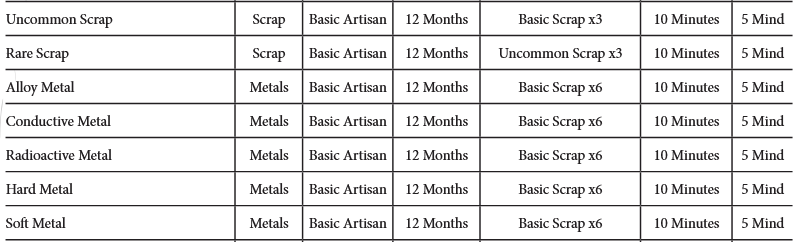
This mechanic allows you to convert Basic Scrap into the various Named Metals you might need in armor, weapons, or vehicle projects, and it even allows you to combine Scrap into a higher tier of Scrap. The added benefit of this skill use is that this effectively RESETS the expiration date of the scrap, as the new scrap you make has a brand new expiration date. This will be an important tool for converting the more common types of scrap and extending expiration dates moving forward.
What is your favorite method of acquiring Scrap? Let us know on Discord!

That’s it for today, Vados!
We have tickets on sale NOW for our next event, SEEDS OF CORRUPTION. Next time, I’ll cover a bit more into the story you can expect to see in February, including our usual content warnings, themes, and inspirations. See you soon!