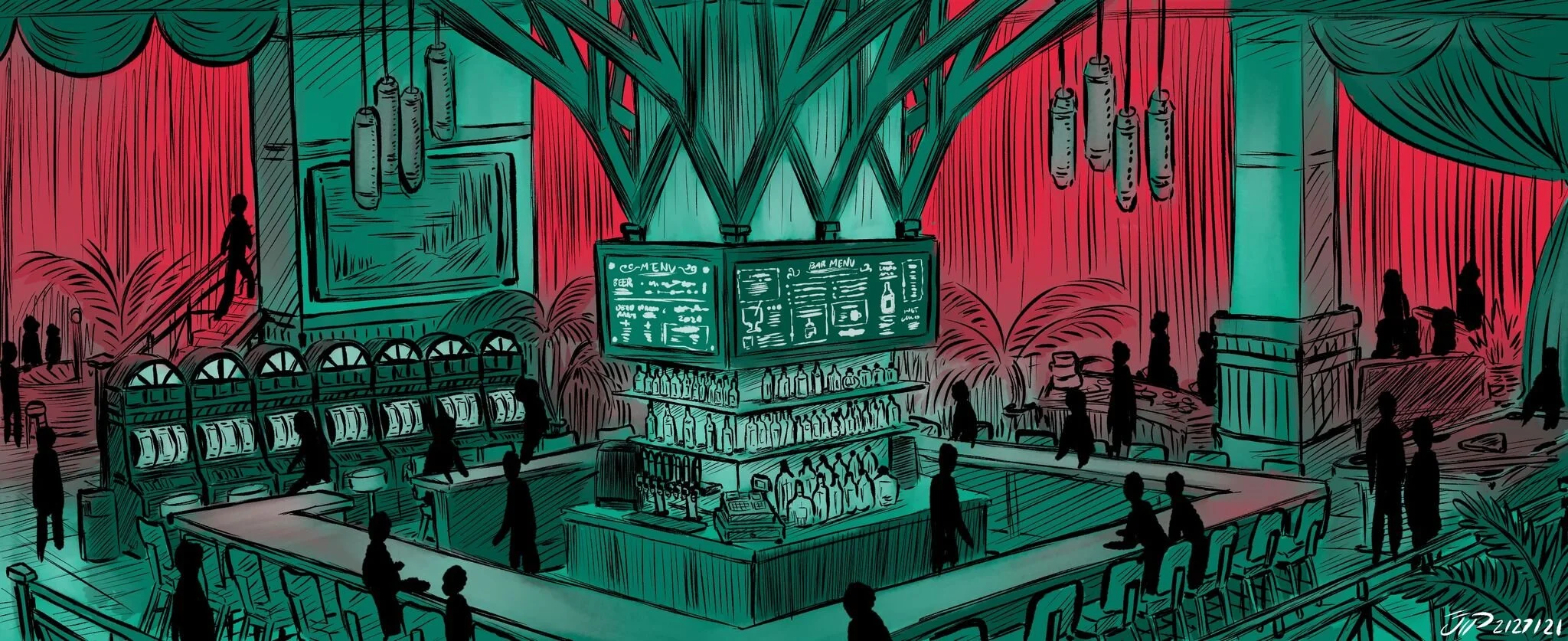
Essex, the City of light and sound
Essex is the first and largest stop on the Oxline; the iron-wrought path of industry slowly decaying across the San Saba Wasteland after the last war. A city of light, sound and rare natural beauty, Essex is most known for hosting a number of festivals and celebrations led by the city’s prominent population of artists, musicians, and crafters. Essex is split between a largely transient population of merchants, refugees, nomads, and visitors from abroad, and the local industry that has grown up to support the needs of the outsiders.

Culture and Festivals within Essex
The city of Essex earned its name by being a tourist destination. The town’s population ebbs and wanes during the festival season, when a series of music concerts, art exhibits, and other entertainment sprout up around the city. While virtually every week has some random pub crawl, battle of the bands, or other musical event, there are a few larger celebrations of note.
The Straw Boss Election
Each year at the end of the Burning Season, Boss Debs hosts the election for the new leadership of the Essex Districts, and those few that will represent the people of the city and bring their concerns to her. There are between 20-30 different smaller sections of the city carved out by the elections, depending on the annual census of residents that call Essex their actual home and not just a travel spot. Debs also runs for election as Mayor at the same time, but she has yet to have any serious contenders to challenge her reign. The union boss is beloved by most of the city, and she works tirelessly to help enact her vision for a union town. The democratic process is hosted within the Grave Bureau, and any person that can have at least 50 others speak on their behalf can put their name into the contest. In practice, each of the major factions sponsors a chosen representative for the largest districts to make sure their needs reach the ears of the Mayor, but there are occasionally upsets among the people, particularly for former Straw Bosses that didn’t take to look after their chosen constituents. Despite the threat of bribery or corruption, the Straw Bosses tend to take their jobs seriously and work to genuinely represent the people of the City of Light and Sound.
The Dead Man’s Hand Tournament
The High Rollers sponsor a high-stakes poker tournament in the Brass Rose each year, usually near the start of the colder season. The week-long tournament is echoed across the bars of Essex, with smaller tournaments hosted for those that cannot afford the buy-ins at the fancier clubs and establishments. Cardsharks, gamblers, and the desperate alike compete for the grand prize, a mountain of Brass that could help any lucky winner live a life of luxury for years. Many of the influential factions of Essex often add other prizes to the pot, and several priceless artifacts and art pieces have been included among the winning pots over the years. A flurry of activity in the basements of the Brass Rose and the VIP lounges for their most exclusive guests has been suggested to be tied to an illicit means to purchase Infection, with no questions asked. Villains across the wastes are often sighted in Essex for the Tournament, but few are there to play cards. The mercenaries of the Black Tide Hunters and the lawmen from the Arbiters of the Bond often follow in their wake, hoping to catch a criminal in a mistake that can end up with them behind bars, or collecting a fat bounty.
The Festival of Light and Sound
Each year in the spring, Essex hosts the largest King’s & Queen’s Court celebration in the wasteland. A week-long festival of bands, music, and food is perhaps the largest attended gathering in Essex, despite a tendency towards chaos that these larger events bring. Before the war, it was something of a joke that terrible things would happen during the Festival, as the both Archon incursions happened during the event, and the first Dead Man’s Hand tournament. Since the war, the Festival has continued to grow, and this is the busiest time of year for the merchants, bars, and shops of Essex. An annual Battle of the Bands, hosted by the crooning tones of Johnny Atom, Frontman of Essex, is the highlight of the festival, setting off a competition to crown the best musician in all of the San Saba wastes. The winner of the Battle never pays a bar tab for the next year, though a few bars have found convenient ways to avoid hosting a winner that tries to abuse the system.
The Fountain’s Heart
One of the newest holidays of Essex, the Fountain’s Heart is a time of remembrance and mourning of the fallen of the war, that ends with a candlelight vigil near the Fountainheart. The Tribes of Seasons usually takes this time to lead a holy ritual, consecrating the land once more, and takes donations for the maintenance of the Thicket from the citizens of the town. The shrine within the Atrium of the Fountainheart is open to the public during the festival, as it is usually fiercely off limits by any but the Antler Guard. In true Essex fashion, the Fountain's Heart festival traditionally ends with the Essex Pub Crawl, a drunken parade through the Green District that lasts until morning. Even a somber memorial finds a way to appeal to the local businesses and draw in a crowd from across the wastes.
Collection Day
A “holiday” of sorts, Collection Day is when the Grave Tax comes due, once a year. This event normally occurs during the oldcestor month of April. During Collection Day, the forces of auditors, accountants, and taxmen take to the streets of Essex to upkeep the ledgers of life and death, collect interest on the debts they are owed, and keep tabs on those who would irritate the balance of power in the city. During this time, the fees for Graverobbers skyrocket in price, and people across Essex strive to avoid an untimely death that could earn them a trip to Cistern, or worse. Some say that if you cannot pay your debts, the Collectors could attempt to “close your account” for good. For the foolhardy sorts, the Reckoners hire mercenaries for a great cleansing of the zed tunnels, ensuring the system they use to funnel undead to the Dead Drop remains functional for another year.
Essex is older than it looks, and is built on the ruins of a city that came before it, and perhaps those ruins sit atop older ruins still that date back to before The Fall. During the last days of the War of Antlers, the city was devastated during the Battle of Essex, when the villainous Chairman turned his artillery on his own population. In the years of rebuilding since, the city has simply added another layer atop the ruins and scars of the war that ended the control of the San Saba Board.
Essex is currently led by the former Queen of the San Saba Republic, “Boss” Lucy Debs. A popular Mayor and hero of the Rebellion against the San Saba Board, Boss Debs has organized the city into various smaller districts led by her Straw Bosses, elected representatives of the people she serves. The city is equally influenced by powerful factions like the Local 727 labor union, the mysterious tax collectors and mystics of the Grave Council, and the Rusted Rail Conglomerate, or RRC, the genius behind the marvelous rail system of the San Saba.
The city is formed into a rough circle, split into four quadrants by the Oxlines and roads that run through the city, surrounding a densely forested area called the Thicket. The great oldcestor interstate, the King’s Highway, bisects the city as it connects Star City to the north, all the way to New Austen and the ruins of Sand Tonio to the south. Trade arrives from across the San Saba via rail line, caravan, airship, and via the docks that border the Amberdraught River. A massive zombie-filled chasm known as the Dead Drop creates a natural border to the north, crossed by a bridge of steel and engineering grit that showcases the might of the city's powerful union factories.
The most prominent landmark at the center of the city is the strange and marvelous stone tree known as “the Fountainheart”, surrounded by a dense maze of vegetation and forested growth that has spread throughout the city. The majestic tree is a prominent symbol of the city’s rebirth after the war and a holy shrine for the Tribe of Seasons, and the fanatical Antler Guard. The Thicket is also home to the Brass Rose & Casino, a majestic hotel, bar, and gambling den established by the powerful High Rollers, and host to the annual Dead Man’s Hand tournament.
To the northeast lies the Scrapes, a ruined area of tall buildings and rubble from before the fall that provide a busy crossroads for traffic by airships and zeppelins, policed by the local Nomad conglomerate called the Cloudskippers. A network of labyrinthian corridors and limestone caverns run through the lowest levels of the ruins and beneath the Scrapes, called the Undercity. The growing population of Gorgers, miner unions, and the less fortunate refugees from abroad that call the tunnels home work tirelessly to bring up scrap, stone, and metals from the ruins to trade with outer settlements and to feed the rebuilding efforts of the City of Light and Sound.
The southeast quadrant of Essex, the Rail District, is dominated by the Oxyard, and headquarters of the Trust, the elected leadership of the influential Rusted Rail Combine. The musicians and academics of Essex have also recently established the Academy of Light and Sound nearby, featuring one of the most well-curated libraries in the San Saba and the Lone Star, which strives to prevent the next war by educating the populace with the lessons of the past. At the far southern corner lurks the Cistern, a towering factory building and old water treatment plant that protects the most well-regulated morgue of the metropolitan wasteland city.
To the southwest lies the Green District, the heart of commerce and trade, and center of the tourist trade in Essex, bordered by the river from the north. The constantly shifting streets of music clubs, bars, restaurants, boarding houses and hostels provide a steady stream of Brass for entrepreneurs and the wealthy elite of Essex. The Veraincineo Music Factory and festival grounds near the Thicket remain the shining star of the town, serving as the primary venue for most of the large-scale celebrations that are hosted by Essex. One former bar-turned-memorial, the Drafthouse, has been repurposed as a museum that enshrines the lessons learned through fire and blood during the War of Antlers.
The northwest Grave Quarter is home to the largest building in Essex, the mighty Grave Bureau, home to the enigmatic Grave Council and heart of politics of the city, hosting forums and town meetings for the various representatives of the people. This district is bolstered by various union halls of the Local 727, the powerful labor union that backs the mayor of Essex, the over-worked doctors of the Union Medical Center, and the Paper Mill, a source of textiles and parchment that keep the various tax collectors and industries of the Grave Council and RRC running smoothly.
The city is on the verge of a new renaissance, with the newly constructed Bridge 34 connecting the settlement once more to the San Saba wasteland by rail. With the reopening celebrations, Essex has drawn attention from across the Lone Star, particularly as the crises at Pride’s Hold to the north make it a juicy target for the dominating Raider threat. The same openness that makes Essex an influential trading hub makes it equally vulnerable, with no walls or serious defenses amid the vast Lone Star prairie. Split between the politics of the Tri-City Alliance and the powerful machinations of organizations like the Grave Council and RRC, the fate of Essex will determine the fate of all of the inhabitants of the San Saba.

Living in Essex
Most visitors to Essex are often drawn to the town by the promise of industry, trade, or entertainment, but only a few stay for good. The constant noise, the odd hours of celebration, and the frequent arrival of outsiders by train makes for a chaotic home. The seedy underworld and corruption of the entertainment industry of Essex can prey on the have-nots and visitors, while rewarding those that manage to skim what they can from the tourists of the City of Light and Sound. Those stubborn few that have taken permanent residence in the city have a fierce loyalty and dedication to the town, particularly if they survived the devastation of the War of Antlers. “Even the bombs of the Chairman couldn’t take their city away”, is a common saying, intoned through a popular song in the bars of Essex.
The town is populated by both the constant influx of gamblers, tourists, refugees, and traveling merchants arriving in Essex to see the sights or make a quick fortune, and those that operate the bars, casinos, brothels, and hostels of the destination city. There is a unique resentment between those that actually live in Essex and those that simply are visitors, a seething conflict that lurks just beneath the surface. While good old-fashioned southern hospitality, warm smiles, and welcome greetings are quickly flashed to potential customers, many residents of Essex only really relax around their own. The city is dependent on the trade and tourism the outsiders bring but is still wary of the way it will change their home. The unique ways to “other” the outsiders and tourist’s feeds the too familiar struggles of in-groups and out-groups, and the violence that is inherent to that conflict. An unwary or oblivious tourist can find themselves meeting a swift end down a tight alleyway if they aren’t careful, but there are plenty more where they come from just in time for the next King’s Court concert.
While the standard dangers of the wasteland can threaten Essex from time to time, the town has proven fairly durable to these stresses so far. Each district has a number of communal concrete fire shelters for use during the Burning Season that can easily double as storm shelters or protection from roving zed, and the Straw Bosses are in charge of orderly evacuation to shelters during major incidents. It may not be comfortable, but there are rarely those without some semblance of shelter or safety in Essex. There is a ready supply of fresh water, both from the Amberdraught River and the plentiful natural springs, aquifers, and cisterns supplied from the limestone caverns below the city.
Supplying enough food to the city is both a major industry and challenge by itself, as the ravenous needs of the town are a parasitic drain on every farm and homestead in a 10-mile radius. However, the flowing Brass from the businesses of the town make it well worth the trip to the city to supply another season’s harvest to the hungry mouths of its citizens. Famine and food scarcity are a constant worry for the poorer residents of Essex, and many take to scavenging through the remains of festivals and trash in the Green District, or in the ruins of the Undercity and the Scrapes to eke out a meager existence. Boss Debs frequently organizes food drives for the less fortunate, though there is never enough to fully supply the needs of the refugees and pilgrims.
Zed are a frequent issue for a town with as many morgues as Essex, particularly when the zombie hordes of the Dead Drop manage to escape the sheer cliffs of the chasm. However, the network of fire shelters and evacuation plans keep the majority of the local populace alive, even if the tourists commonly fall prey to the roving threats. The city has grown adept at funneling the undead through the city to the roads and rail lines leading away from Essex, before quickly returning back to business as usual. A quick once over to wash away any blood and gore from unfortunate visitors, and the music plays on. The skyships of the Cloudskippers usually provide early warnings of any major threats approaching the city, but smaller sightings of roving Raider warbands or small packs of undead within the city can be an insidious threat for any that make the pilgrimage to the City of Light and Sound. The brutal necessity of surviving the wasteland may be distracted momentarily in the glitz and glamour of the lights and sound of Essex, but the danger remains.
Outside of the entertainment and tourism industry inherent to Essex, the town is home to the vast bureaucracy of both the RRC and the Grave Council. The two major factions that call the city home are as crucial to the infrastructure of the town as the music festivals. Each faction draws their own visitors and tourists, in the form of the Oxyard and RRC headquarters, where the precious locomotives of the Oxline are housed and repaired, and the Grave Bureau, where the tax collectors and mystagogues manage the maintenance of morgues across the San Saba. A massive oldcestor paper mill in the Grave Quarter is a major source of exports from Essex, providing crudely recycled paper to the auditors of the Grave Council, the unions of the RRC Trust, the printing presses of the Local 727, and to the San Saba at large. The RRC’s new focus on delving into the ruins of Morgan’s Folly to the north to bring back oldcestor relics, scrap, and supplies has proven profitable for Essex, and there is always employment for those willing to risk the dangerous raider-infested outskirts.
Crime and grift are an unwelcome fact of life for many in Essex, despite the optimistic promises of Boss Debs and her Straw Bosses. Any city that sees the traffic that flows through Essex is bound to develop an industry of its own supplying drugs, protection, or other illicit goods to their discerning clientele. While the High Rollers of the Brass Rose are the most obvious source of criminal enterprise in Essex, there is always some district riddled with new gang violence or crystal candy trafficking. The seedy underbelly does its best to maintain a veneer of respectability and innocence on the surface for the tourists, but virtually anything someone desires can be found in Essex for the right price.
Traveling to Essex
The city of Essex is a purposefully porous city, attracting traveling from across the San Saba and the Lone Star. It is easy to access by various means of travel, by caravan, rail, or sky, and the population ebbs and flows with the arrival of outsiders around major social events.
By Land - The largest surviving oldcestor road, the King’s Highway, carries travelers through the middle of the San Saba, bypassing the ruins of Morgan’s Folly to the north, the Devil’s Gorge near Bastion and Bravado, and all the way south towards New Austen and the ruins of Sand Tonio. The road is mostly intact thanks to the tireless effort from a clan of Sainthood Diesel Jocks, and allows the various wasteland vehicles to make a decent pace through the prairie and wilderness of the San Saba. The interstate ruins pass near Pride’s Hold and the former settlement of Temple Station before reaching north towards Star City and Fort Worthless. Outside of the main road, the open prairie allows bumpy offroad travel into Essex from the north, east, and south.
By Rail - The RRC has connected each of the major settlements in the San Saba by an ambitious network of rail lines called the Oxline. The rickety locomotives of their fleet carry train cars to and from destinations abroad, but the scope of the rail system has dramatically decreased in the years after the war. The outer reaches of where the Oxline used to travel have largely deteriorated due to lack of maintenance and the harsh conditions of the wasteland, and only the closest connections to Essex remain functional. For several years, easy access to Essex was challenging, as the Dead Drop expanded across and collapsed the main rail connection into the town. Trains would need to stop, unload their cargo north of the chasm and make the final trek on foot and caravan, making it a risky and time consuming process. With the finished construction of Bridge 34, the rail lines once again connect Essex to the northern towns of the Tri-City Alliance.
By Water - The crucial waterways of the San Saba, from the northern stretches near Lake Bravo and Bastion reach past Essex and beyond, connecting the region by a winding network of shallow lakes and rivers. The industrious Junkerpunks manage the riverways, sending shipments of scrap and food back to feed the ravenous needs of the larger city. While the route is slower than by land or rail, it tends to be more reliable as the zed and raiders often cannot meaningfully challenge the river traffic.
By Air - The best but most expensive route into Essex is by airship or zeppelin, and the towering spires of the Scrapes make for easy docking and berthing while in the city. The Cloudskippers manage the largest airship dock, the Spire, charging fees and protecting the vessels that arrive from abroad. The annual Cloudskipper Regatta attracts airship pilots from across the wastes, proving their skill by weaving through the Scrapes on a challenging obstacle course.


The Five Districts of Essex
The city of Essex is separated into five major sections following the reopening of Essex after the War of Antlers. Each section has several prominent locations and landmarks of note.
The Grave Quarter
The Scrapes
The Thicket
The Rail District
The Green District
These locations are not the only things in those areas, just a few of our plot hooks and locations to feature during online modules.
Locations of Note - The Thicket
The most prominent landmark at the center of the city is the strange and marvelous stone tree known as “the Fountainheart”, surrounded by a dense maze of vegetation and forested growth that has spread throughout the city. The majestic tree is a prominent symbol of the city’s rebirth after the war and a holy shrine for the Tribe of Seasons, and the fanatical Antler Guard. The Thicket is also home to the Brass Rose & Casino, a majestic hotel, bar, and gambling den established by the powerful High Rollers, and host to the annual Dead Man’s Hand tournament.
The Brass Rose
Within the Thicket, the newest saloon has become the breathing, beating heart of culture, music, and wealth in Essex. The business is a joint venture between the former proprietor of the Elbow Room; a bar that is now a hole in the ground, and a wealthy Vegasian from Bravado. The saloon famously sells the Amberdraught beer that earned this town its fortune, but no one knows quite how they obtained the recipe from the late Governor’s wife before she was assassinated. A shiny, brassy affair with three stories, The Brass Rose is publicly operated by an ancient Ironborn named Rose whose arms, as strong and sure as anything, bear the scars of a lifetime of hard work. Rose runs their bar with, as the saying goes, an iron fist. They have two adult children who run their in-house distillery (a casual competitor to the Amberdrought brand) and an enby partner who keeps the garden out back.
The main casino floor is open to the public, and bets on virtually any contest of skill can be made, provided you can stake the funds. Brass, scrap, herb, and more flow through the coffers of the Brass Rose, and there are always new travelers willing to make a bet at their chance of fame and fortune. The annual Dead Man’s Tournament draws gamblers from across the wastes, and the risk only goes up. The VIP bar within the back halls of the Brass Rose is known as “the Grin”, and is only open for discerning clientele hand picked by the sultry proprietor, Desire. They are an open representative for the High Rollers, organizing entertainment and illicit activities in the backrooms for members of the criminal elite.
The Fountainheart
The massive tree that grew out of the Fountainhead during its last breath is the largest structure and most notable landmark now within the City of Light and Sound. At the center of this massive, twisting tree is a mostly defunct morgue, a towering edifice of white stone pockmarked with holes that look like they should roost pigeons - and these days they often do. Large branches drooping with foliage grow from the holes and stretch to the heavens far above the city. Enormous, thick fungal cables intertwined with massive roots plunge into the dirt - presumably once powering the ancient morgue. The shell of the Fountainhead is now encased entirely within a vibrant and massive tree that can be seen for miles in every direction - a last testament of the Fountainhead’s legacy.
The front of this structure used to have a blast door - but now only the hinges remain and the Atrium inside is largely unlit and vacant. A small shrine, painstakingly maintained by the Antler Guard is kept within, but the tree has been declared accorded holy ground by the Tribe of the Seasons. The pacifist monks have eschewed weapons and live a life of humble service maintaining the foliage of the Thicket. There is a private collection of texts still kept here, in memory of the former House of Books that once inhabited the space. The former morgue is mostly defunct, but still certified by the Grave Council on a regular basis, just in case. No one knows if the morgue could reactivate, but most hope that it never stirs.
The Amberdraught Apiary and Distillery
Though the original distillery was destroyed in the war, the last scion of the Amberdraughts never forgot her roots. Augustine and Audelia Amberdraught made their fortune as distillers and brewers, and the legacy of Amberdraught Beer lives on at the Apiary, reimagined by their surviving niece, Missy. The insects cultivated here help give the honey collected the distinctive taste the sweet, crisp, beer is known for (now with expanded options! Including meads and sweet, floral, liquors), and the cozy interior offers an alternative to the lights and noise of the Brass Rose for customers wanting to relax. While the beverages served at the two bars are theoretically the same, Missy promises the authentic experience for those with a discerning palette and appreciation for hooch.
Locations of Note - The Green District
To the southwest lies the Green District, the heart of commerce and trade, and center of the tourist trade in Essex, bordered by the river from the north. The constantly shifting streets of music clubs, bars, restaurants, boarding houses and hostels provide a steady stream of Brass for entrepreneurs and the wealthy elite of Essex. The Veraincineo Music Factory and festival grounds near the Thicket remain the shining star of the town, serving as the primary venue for most of the large-scale celebrations that are hosted by Essex. One former bar-turned-memorial, the Drafthouse, has been repurposed as a museum that enshrines the lessons learned through fire and blood during the War of Antlers.
Veraincineo Music Factory
The grand stage of Essex has a wide open area for attendees to gather, and is frequently used for festivals, bi-weekly produce markets, and speeches from local Straw Bosses and officials. Every bit of the industry of tourism is present at the Music Factory, from overpriced hooch, to cheaply made shirts to sell as collectibles of your time in Essex. Vendors and DJ food trucks have a dedicated spot to set up shop, catering to the business during the busy festival season. The speakers and ancient electrical equipment that gives the City of Light and Sound its name is lovingly tended by the faithful of the King’s Court. There is a small shrine of collected treasures gathered from across the San Saba, including a mostly functional juke box.
The Drafthouse
Once the pride and joy of Malorous Mab, the Drafthouse has been converted into a living memorial of the War of Antlers, recording the history and memories of what came before. A subtle and obvious jab to the former ‘queen’ by Boss Debs, the Drafthouse is a legacy of the former Tribes Disparate, and almost a holy ground for veterans of the war. The bar here offers free drinks to any that can share a story of how they served, and a tacky gift shop offers cheap replicas and curios for visiting travelers. The two story pub is a frequent destination for tourists, and the transformation of the bar from a seat of power for Mab to a reminder of her betrayal is not lost on the exiled queen from her new post in the Paradise Bar.
Ellum’s Deep
The winding main roads of bars, music clubs, and restaurants within the Green District hosts a frequently rotating cast of characters, as businesses open and close to meet the fickle needs of tourists. The businesses here are a tourist destination in their own right, and the Essex Pub Crawl is a grand tradition and drinking challenge made famous in Ellum’s Deep. Music of every genre can be heard wafting out of bars late into the night, and only the early mornings are quiet. The few remaining drunks are shooed away, to provide time for the Sanitation Union to return the streets to a pristine appearance for the next night’s crowds.
The Essex Docks
Access to Essex by water is limited, but the riverways and canals connect the city to the Spoiled Coast and the waterways near Lake Bravo. The Docks aren’t quite as large as you’d expect for a city the size of Essex, but they are efficient and well maintained. Saltwise shipwrights, Rover merchants, and sailors of the Junkerpunks make this area nominally neutral territory, despite their focus on Drywater to the north. No one wants to risk losing a berth in the Docks and the chance to supply goods to the greedy needs of Essex by getting caught for simply piracy. Sailors and pirates of every calling try to keep the violence reserved until they are outside the range of Essex.
Ladybird Botanical Gardens
Once a few overgrown acres along the edge of a dwindling stream that feeds into the Essex Dock system downstream, the Gardens have been renewed by a few of the local Straw Bosses. Where the water and soil was irradiated and questionable, the Fountainhead’s last act has breathed new life into the area and corrected the wrongs of this once forgotten green space. Now, the Gardens have become a public place of interest for Missy Amberdraught and as a stark contrast to wild growth of the nearby Thicket, features at the center a white gazebo on the highest hill slope surrounded by neatly manicured flowers. Missy hopes to share her vision of a restored and elaborate garden with the rest of Essex, and as a quiet place away from the noise of the busy Green District.
Locations of Note - The Grave Quarter
The northwest Grave Quarter is home to the largest building in Essex, the mighty Grave Bureau, home to the enigmatic Grave Council and heart of politics of the city, hosting forums and town meetings for the various representatives of the people. This district is bolstered by various union halls of the Local 727, the powerful labor union that backs the mayor of Essex, the over-worked doctors of the Union Medical Center, and the Paper Mill, a source of textiles and parchment that keep the various tax collectors and industries of the Grave Council and RRC running smoothly.
The Grave Bureau
Located in the middle of the Essex metroplex, the Grave Bureau is a great stone building evocative of a church - but mostly a bank. Painstakingly carved triple-headed lions flank the front doors of this marble hall and quiet teller stations line the walls of a stately waiting room. Accountants keep meticulous tabs of Grave Taxes and fees owed to the Sanctioned Graverobbers that ply their trade across the San Saba. The debts of the Lonestar are recorded in the steel vaults below the Bureau, and the whole place smells faintly of rot, no matter the time of year. The upper levels of the surface building are reserved for the operation of the Grave Council’s league of auditors and tax collectors. There are several lower levels that are reserved for Grave Council business, and the Vaults of Reckoning once were housed in the caverns below the building.
While the quiet sanctity of the building was once unquestioned, the main floors of the Bureau have been repurposed as a town hall and indoor gathering space for the city’s politicians. The former barracks assigned to the Reckoner Legions were made into public sleeping spaces for travelers and the less fortunate. While they may be cramped and uncomfortable, the shared space is rarely empty. The unions of the town take turns providing meal services to those in need, though the accommodations are sparse and pale in comparison to the fare you can find elsewhere in the city for the right price.
It is often thought that the Grave Bureau is connected to each of the morgues of Essex through a network of tunnels below the building, but the Grave Council declines to confirm the rumor. There is a waiting area and lobby on the upper levels for the recently returned from the Mortis Amaranthine to report their Grave Tax, and there is some access to the Mortis below the building. The levels below represent a labyrinthine maze of bureaucracy. There are endless stacks of shelves, cabinets, ledgers, along with hundreds of Full Dead and Retrograde clerks. The Imixin tribe’s religious priests have several anointed chapels and quiet places set up within the Bureau. Ritual circles, quiet meditation rooms, and more.
At the base of the complex, in the heart of the former Vaults of Reckoning lies the Midnight Orrery. The fantastic crystalline and brass orrery seems to move to some hidden symphony, and has a direct connection into the Mortis Amaranthine via fleshy, fungal cables. The mystics of the Grave Council claim that the strange necrology device allows them to read the balance of the biomass of the Mortis, but this is mostly the ravings of zealots. The relic is the heart and soul of the Grave Council, and none but the highest ranking members of the faction have laid eyes directly on the Orrery, past the loyal members of the Mystagogues.
The Paper Mill
In the ruins of an oldcestor factory, the Paper Mill has been refurbished by the Local 727, a group of specialists work on restoring and refining the processes of recycling paper and making new paper and textiles from various fibrous flora. The industries of Essex rely on the paper produced here, and the factory is a big part of the exports of the city. Paper is hard to find in the wastes, and propaganda and letters across the wasteland can probably trace their origins back to the Essex Paper Mill. The factory operates night and day, the loud noises of the machines can easily deafen those that don’t wear protective gear. The engineers of the mill take a reverent approach to maintaining the decaying machines and keeping the rollers operating at peak efficiency. Every musician needs sheet music, every accountant a ledger, and every politician a new batch of campaign posters, so the Mill is accorded neutral territory for virtually every faction in Essex.
The North Hallows
A small, but functional morgue exits near the Grave Bureau, and offers access to the union Necrology labs within the Mortis. The morgue is staffed by the Sanctioned Graverobbers and Mystagogues of the Council, and a tunnel below the morgue building properly helps funnel any errant undead into a system that feeds into the Dead Drop. Reckoners from the nearby Grave Bureau can quickly respond to threats, but the primary morgue at the Cistern is usually where the recently deceased emerge if they die in Essex. The morgue is hallowed ground of the Imixin cult at the heart of the Grave Council, as it was the first morgue planted upon the arrival of the nomadic Gorger and Unborn priests to Essex.
Union Medical Center
Formerly a private hospital for the wealthy in Essex, the Medical Center was crucial to the survival of many victims of the Chairman’s bombing. While it was originally meant to cater to only the aristocracy, Boss Debs personally led a refugee group into the building and started triage. Anyone that needs urgent care can seek help here, no matter their social class or means of payment. The Medical Center offers training to any that want to help their fellow survivor, and are a big part of the Straw Boss evacuation plans. Each district wants a certain number of rescuers available to serve their constituents in a time of crisis, so every group pitches in to make sure the hospital has the funds to continue their good work.
The Union Halls
In Boss Deb’s grand vision for Essex, the laborer is a protected class in the city. When the city was devastated in the war, the homes of the elite and wealthy largely escaped unscathed. Debs democratized the homes, and repurposed them towards the functional government of Essex. The various supporting industries of Essex are largely unionized, in a homage to the Local 727 faction. The Sanitation Union, the Farmer’s Union, and more hold offices in the spaces that used to be the homes of the aristocracy of the city. They help organize the operation of the town, and keep detailed plans for the city’s new layout. The printing presses of the unions are running almost 24/7, sharing the vision for Essex with the people through print and journalism.
Locations of Note - The Scrapes
To the northeast lies the Scrapes, a ruined area of tall buildings and rubble from before the fall that provide a busy crossroads for traffic by airships and zeppelins, policed by the local Nomad conglomerate called the Cloudskippers. The skeletal remains that used to be the corpses of buildings now appear almost like vertical forests in the wake of the Fountainhead Incident. The buildings host a thriving ecosystem of bioluminescent fungi and all manners of flora not normally native to the Lone Star.
The Undercity
A network of labyrinthian corridors and limestone caverns run through the lowest levels of the ruins and beneath the Scrapes, called the Undercity. The growing population of Gorgers, miner unions, and the less fortunate refugees from abroad that call the tunnels home work tirelessly to bring up scrap, stone, and metals from the ruins to trade with outer settlements and to feed the rebuilding efforts of the City of Light and Sound. The growing resentment towards outsiders festers within the Undercity, fed by the riotous preaching of the Rook and the brutal philosophy of survival enforced by the Lascarian tribes that call the tunnels home. Despite the conditions, the survivors that choose a life in the Undercity are fiercely loyal to their own, and proud of the struggle they face without needing to rely on handouts from the unions of the city.
The Regatta Proving Grounds
A semi-annual race between the sky captains of the Cloudskippers has a permanent course marked high in the towers of the Scrapes. The long flag poles extend from the buildings, marking the routes an airship must follow to complete the Regatta. Airships aren’t usually very maneuverable vehicles, so completing the course is a true testament to the piloting skill of the team that competes. Some of the flag poles are festooned with sharp scrap and sharpened steel rods to add a bit more spice to taking a turn too quickly. DJs and Nomads across the wastes will generally attempt a run of the Regatta when they visit, just to say they have the chops to navigate between the twisted spires of the Scrapes.
The Spire
The airship docking spire is one of the tallest structures in Essex, and is a central receiving point for zeppelin and airship traffic arriving in the city. The Cloudskippers collect dues and docking fees from non-union affiliated merchants, but the secure berths and easy access to the Oxline make this an easy expense to justify. The sky captains have cultivated the bioluminescent growths around the spire, and with each passing month the docks appear more like branches on a large, glowing tree. The Cloudskippers have many odd traditions and superstitions, and those that cannot provide a story or comply with the strange requests before they embark are often assessed a fee for not being properly respectful to the cultures of Essex.
The Towers of Frost
An ancient oldcestor structure, this dilapidated highrise building sits just outside Essex proper. Broken letters mark the name of the building on the tallest floors, but most avoid the tower. The broken building is habitually a nest for Raiders and even various zed, but some residents of Essex swear that they’ve seen an airship docking at the top of the tower at night. The floral growth common to the Scrapes has withered and died in the upper reaches of the tower for some unknown reason, so the top levels remain unnervingly dark at night, especially in a place like the City of Light and Sound.
Locations of Note - The Rail District
The southeast quadrant of Essex, the Rail District, is dominated by the Oxyard, and headquarters of the Trust, the elected leadership of the influential Rusted Rail Combine. The musicians and academics of Essex have also recently established the Academy of Light and Sound nearby, featuring one of the most well-curated libraries in the San Saba and the Lone Star, which strives to prevent the next war by educating the populace with the lessons of the past. At the far southern corner lurks the Cistern, a towering factory building and old water treatment plant that protects the most well-regulated morgue of the metropolitan wasteland city.
The Rail District is home to the frequent arrivals that travel to Essex, and the population of the quarter ebbs and flows with the schedule of the Ox. Most of the trade that arrives in the city first arrives by rail, and the district has been shaped into an iconic entrance for the city. The renewed trees and growth left by the Fountainhead create a welcoming arch as the Oxline first passes into the station, and various vendors and merchants set up shops in the streets nearby hoping for the first crack at Brass from the tourists. A big portion of the buildings in this district are hotels, hostels, and lodging halls, offering affordable (and slightly less affordable) places to stay and take shelter for guests to Essex.
The Ox Yard
This central train station sits in the middle of the city - Essex being built around it from its inception. Despite the growth of the forest around the area, the Ox Yard was quickly cleared to ensure smooth operation of the rail line. A huge circle of grassless dirt, partitioned off with ancient cattle guard lies in the center, where the shipping containers either recently unloaded or imminently to-load are stored. Throughout the Yard are the stumps of former trees that have been removed to clear the path for the Ox. The poorest of Essex and the surrounding wastes often find work here, but the labor is back breaking. Laborers looking for their next meal unload cargo from shipping containers into flatback pickups and deadsleads to be carted across the greater San Saba wastes. Tent-houses and lean-tos take up an entire fourth of the Ox Yard - with entire derelict shipping containers being repurposed as small pubs and commonhouses that cater to the unions of Essex.
RRC Headquarters
The center of the powerful Rusted Rail Combine’s influence has a home in Essex, rebuilt after the devastation of the war nearly wiped out the Ox Yard. From the first days of the city, the faction has been responsible for the network of rail lines that connects the San Saba and beyond, though their once grandiose plans of connecting the wastes have been withdrawn to something more reasonable. Now, the 51% stakeholders within the group collectively call the shots for the faction’s business, through an organization called the Trust. The Trust’s officials usually take a union title, like Steward or Foreman, rather than use their actual names, emphasizing that they only hold power while the majority of the faction deems them worthy. While many of the powerful Elitariat families like the Prufrocks, the Kiplers, the Buzzbees, the Kwolks, the Tinstruments, and the Dellison-Hackards still have considerable weight in the business, none want to risk the ire of the people by stepping into the limelight following the last Chairman’s disastrous end. Kazimir Veraincineo is still in charge of most of the day-to-day affairs of the RRC locally, but enjoys most of their time managing the portfolio of growing interests in the tourism industry of Essex while the Trust handles the larger affairs.
The Mayor’s Office
Boss Debs maintains a well-known residence in the Rail District, choosing to place her offices and living quarters near where people first arrive in Essex. A large gathering yard is kept outside the building, perfect for hearing speeches from Straw Bosses, or passing announcements to the locals of upcoming city business. The Queensguard keeps a small barracks nearby, making sure that the Mayor is always protected from attempts at assassination. While Debs may have once been thought to be naive, she has certainly learned a lesson from the war. Being placed as a union clerk working for Debs is a high honor, and there are always people jockeying for the position or chance to be near their hero. Debs continually reminds her adoring fans that she will only serve as long as the people deem her worthy, but so far no serious threats have challenged her vision for the city of Essex.
Academy of Light and Sound
One of the earliest traditions of Essex after the Fountainhead Incident was a place called the ‘House of Books’. Based in the Atrium underneath the strange morgue, much of the collected research on Barogue, the Archon threat, and the various crises that faced the city started there. When the bombs destroyed that library, Debs commissioned a new home of research and learning in Essex through the Academy. The Curators helped rebuild the university with donated copies of the materials that had been lost to the devastation, dutifully transcribed for their own unknown purposes. The Sainthood that had upkept the House of Books quickly latched onto the project, and the Academy was truly born. When Johnny Atom suggested that they help teach some of the musicians without a pitch how to carry a tune, the King’s Court turned their considerable influence in Essex into creating the premier home of music instruction in the wasteland, and they began working with the first students. The Academy takes pride in promoting their students for concerts at the Music Factory, and the two locations are intertwined with the tourism industry of Essex. Researchers from the Academy have collected various relics and oldcestor artifacts from across the San Saba, icons of the Kings and Queens of old to lovingly feature in the halls of the Academy, and at the Grand Stage.
The Cistern
The largest functional morgue in Essex, the Cistern is underneath the remains of a water treatment plant from oldcestor times. Long since dried up, the pipes clogged with fungal growths of the Gravemind, this morgue echoes the still of a grave even during the busy trading season. The stark concrete walkways remain empty of animal or plant life, and a skeleton crew of Grave Council employees keep watch here. Despite the usual danger of a morgue, the undead are funneled away from the population centers of the city by a clever series of underground tunnels that evacuate the zombies into the Dead Drop. A contingent of the Reckoner Legions are stationed here in rotating shifts, ensuring that they can control the worst of any horde that emerges. If they need to sound the alarm, a fortified telegraph station quickly alerts the Straw Bosses so they can get their citizens to take shelter until the horde can be directed out of the city.
The Paradise Bar
Located within the basement levels of the Cistern, this small, still operating saloon offers a drink to the recently returned. The basement morgues of the Cistern exit out into the streets of Essex, and the simply painted sign of the bar is often the first sight they see when they stumble back into the world of the living. A tradition of offering a free drink to anyone recently returned is upheld, but the clientele here tends also to attract the rough and rowdy looking for a drunken brawl or a fight with the undead. The proprietor, Malorous Mab, serves out her exile in service to the city, and her Baywalker bartender, Kurt, maintains the premises when she travels back and forth between Drywater. There are always watchful eyes that pay attention to who comes and goes from the bar, and delivers that information back to Mab’s network of spies. There were old rumors of a secret Reckoner black site under the bar for enemies of the Grave Council during the schisms of the war, but you’ll never learn the truth from Mab – just a knowing smile and an offer to refill your drink.
The Morgues of Essex
There are six known entrances to the Mortis Amaranthine near Essex, though not all remain functional to this day. Very few cities ever see these many morgues develop within their borders, and it is not surprising that the Grave Council has centered their might in Essex to maintain them. There were two morgues once active in Essex that are now defunct and closed, one in the Green District and one at the heart of the Thicket beneath the Fountainhead. While it is theoretically possible another entrance into the fungal network of the Mortis Amarantine could be carved, the town has far too many morgues as it is.
A clever series of underground tunnels was built by the Council to funnel undead that emerge from the morgues towards the Dead Drop, keeping the usual undead threats that face a town threatening the outskirts of Essex instead of the populated center. The tunnels have a series of one-way cattle gates installed and a subtle slope, forcing the undead towards the northern chasm that borders the town. A heavily reinforced entrance near the top of the chasm abruptly launches the zombies into the dark below when they emerge, forced to join their brethren by the press of bodies from the horde filtered through the tunnels. The Reckoners keep a careful watch on any obstructions that could threaten the tunnels, but the system has worked well over the years to keep the worst of the undead at bay. It briefly failed during the Battle of Essex, but was a top priority of the Grave Council to repair as the reconstruction effects fought to take back the city from the brink of destruction.
Each of the morgues are all considered property held by the Grave Council and maintained by their Sanctioned Graverobbers and Mystagogues, in accordance with their agreement with the citizens of Essex and the San Saba. Cassiopeia and her Mystagogues oversee the public maintenance of the morgues of Essex, but are assisted in prominent graverobber duties by outside contractors and agents of the Council that visit. While it is challenging to perform certain necrology rituals in the city proper, the Reckoners keep a careful watch on the morgues for any signs that someone is tampering with their domain.
The Fountainheart
The massive tree that grew out of the Fountainhead during its last breath is the largest structure and most notable landmark now within the City of Light and Sound. The last acts of the Fountainhead Incident permanently closed this morgue, sealing the Outsiders within and forever preventing access to the Mortis Amaranthine. While some enterprising Council scholars have attempted to prove that it could be awakened, the fungal growth of the Mortis seems to unknowingly avoid this location. Some suggest the dark spot within the necrological depths could be a stable necropolis, an area where nothing can return from the grave. Few want to risk the implications and panic that might erupt should they understand the gravity of that theory, but the morgue seems well and truly dead.
The Undercity Morgue
Deep with the Scrapes, built in the remains of an oldcestor structure of concrete and metal formerly known as an outlet mall, the Undercity keeps a small morgue that is used by the unfortunates that call the underground home. Once called the Northeast Hallows, the location survived mostly intact during the Battle of Essex, as even the Chairman didn’t see much value in bombing the already ruined Scrapes. The grumpy Lascarians that rule the tunnels see the wisdom in allowing Grave Council to perform their services, and Council agents are one of the few outsiders allowed to pass freely into the Undercity. The same tunnel system that could filter the undead towards the Dead Drop was in place here at one time, but the Lascarians boarded it up, instead preferring the opportunity to prove themselves against any zombies that emerge.
The Former Paradise Bar
While the Paradise Bar was once a fixture in the Green District, it was moved to the Cistern at the orders of Debs, creating a worse location for her once-partner Malorous Mab to serve out an insulting exile. The former bar was boarded up, the morgue sealed, and concrete poured over the foundations to prevent any access to the fungal network below. The Council certified that the quietly ignored location is secure, but there are always rumors and sightings of the undead within the Green District despite the precautions. Essex is a notably easy city to access, so it is far more likely they are simply lone shamblers or other lurking dead that evaded detection or followed behind a group of survivors that arrived into town for a festival.
The Cistern
The now largest morgue in Essex, the Cistern towers above the remains of a water treatment plant from oldcestor times in the Rail District. This morgue keeps a contingent of Reckoners on staff to deal with the worst of the undead threats that face Essex, and the area is heavily restricted from tampering with the Mortis. The stark concrete walkways remain carefully pruned of animal or plant life, and most citizens give the place the healthy respect, and distance, it deserves. It is rare that undead escape the Mortis here, but if they do the Council has a protected system of communication to alert the leaders of the town to enact evacuation and shelter protocols.
The North Hallows
The closest morgue to the Grave Bureau, the Hallows is the primary location for necrological research, Mortis rituals, and other Grave Mind focused procedures performed by the Council’s agents. The morgue is rarely used for returning the recently slain to life, and the area is heavily policed by Grave Council for illicit activities. However, the High Rollers always seem to have access when necessary, and there are notable times when the guard seems to take a spontaneous coffee break to look the other way. Even the Council is vulnerable to the grift and corruption within Essex, but the criminals are careful not to abuse this limited access or risk it becoming a problem that attracts the attention of the Council of Grave Decisions.
The Dead Drop
Less a morgue, so much as a gaping wound into the Mortis Amaranthine, the Dead Drop was once a deep mine shaft descending into the earth on the northwest border of Essex. The bombing of Essex during the war collapsed part of the underground tunnels, and the deep crevice expanded further east during a shockwave. The wreck of the former Oxline that was collapsed still dangles below the new, shiny construction of Bridge 34. There are no ladders or easy ways down the steep, vertical walls of the chasm, but the Dead Drop is normally crawling with the undead. A peculiar strain of shambler has emerged here known as a “leaper” for their tendency to make frantic grabs at any foolish attempt to descend into the depths. Their powerful limbs and mutated sharp claws make climbing the sheer cliffs of the abyss deceptively easy. The yawning chasm still manages to attract its fair share of treasure seekers seeking rumors of oldcestor compounds deep underground, and a few crazy Cloudskippers claim to have flown an airship to the bottom of the Dead Drop. Most stay away from the Dead Drop for good reason, as the Grave Council tunnel system exits near the top of the chasm, sending new undead arrivals occasionally plummeting into the depths.

Nearby Locations Outside of Essex
Bridge 34
When the war collapsed the previous rail line that traveled near the Dead Drop, the Local 727 led the rebuilding efforts, the skilled Ironborn engineers helping repair and reconstruct important aspects of Essex’s infrastructure. The best engineers launched an ambitious project with Boss Deb’s blessing, a plan to cross the Dead Drop and build a bridge of steel and stone instead of simply rerouting the Oxline. The engineering project took almost a year to complete, but became a symbol of Deb’s leadership, and a way to reclaim something from the devastation of the war. The name confuses some, but the union assures residents that it was simply the 34th successful blueprint for the project, and not that their prototypes failed that many times before.
Winsome (north of Essex)
About 30 minutes up the line north after Essex’s station, this tiny walled hillside town holds a weeklong garden festival in the spring. Previously a small affair among the Quiet Ones and Mericans that call Winsome home, the festival has seen its attendance boom in the last two years after becoming fashionable to the Pure Bloods of Essex.
Axiom Farms (north of Essex)
A small scientific community to the south in an area once known as Belton, the farmstead is host to several successful communes that provide food and trade to many of the settlements of the San Saba. The RRC and San Saba Republic work to protect the town from outside forces, but the community’s focus on invention and advancement of agricultural arts has attracted some of the best and brightest minds that survived the crash of Waking.
Widow’s Lament (west of Essex)
The new home of the Lovelace Family, a battered and bruised dynasty of Quietfolk who had lived in the hills far to the north for decades. Quietly, they have tended their land and kept their traditions despite death and heavy losses over the past few years. The Lovelace’s heavy focus on community and family have led them towards a renewed tradition of isolationism. Since the War of Antlers and the loss of their home at Widow’s Peak, the Lovelace Family is wary of outsiders and welcomes almost no travelers into their town. The youngest family members eventually find a reason to travel to Essex on a rumspringa-esque journey of adulthood, so they can better appreciate the safety and security that a life with their family back home can actually provide.
Tremorsands Post (northwest of Essex)
The last stop on the Oxline that once stretched across the Dune Sea, Tremorsands Post is the west-most settlement in the area around Essex. Still the source of the valuable Oxblood that fuels the locomotives of the RRC, Tremorsands stands alone against raider clans, terrible leviathans, and bandits that prey on the weak, protected by the RRC and Blacktide mercenaries that man the defenses. The Cali*Co Caravan hosts a shrine near the Post composed of oldcestor vehicles half buried and sticking up towards the sky as a strange waystation marker on the road towards Hell Dorado.
Fort Jacinto (southwest of Essex)
After the fires swept through the Lonestar after the Burning Season, the Jacintos' former home barely survived. Scattered and separated from their farmlands, they circled the wagons and formed Fort Jacinto. Expecting a last stand, the waves of the undead were relatively light, and they managed to weather the end of the storm. The family members that survived believed they were delivered on high, and that they were chosen to serve a purpose. The rough metal walled compound is still maintained by the loyal Fallow Hope family, and they make seasonal trips into Essex to sell their produce and gather supplies to reinforce their home. They have refused to take sides with the Loyalists to the north, feeling they have bled enough during the War of Antlers to earn a chance at rest.